Tuesday, February 17, 2015

REPOST: 3 Ways to Advance Digital Marketing in Your Organization

Embracing digital marketing can be a difficult project to undertake for many traditional companies. ClickZ.com offers the following tips to help companies make digital marketing a more integral part of their organization:

Image Source: clickz.com

These three tips can help you bring your company to the forefront of the digital marketing scene - are you ready?

Digital marketing, with its constant changes and new technologies emerging regularly, is oftentimes a huge initiative to implement for many companies. While some organizations hopped on board early, making the necessary investments in people, technology, and creative thinkers needed to make digital marketing a central part of their go-to-market strategy, others lag behind their industry peers. If you fall into the latter category – or even if you’re just trying to make digital marketing a more integral part of your organization – check out my three tips to help your initiatives gain momentum within your company below:

1. Brief Executives on What Is Possible.


Executives can be your biggest source of momentum for digital marketing. However, before they give you their full endorsement – along with budget and headcount – they have to fully understand the benefits that digital marketing will bring your company.

To ensure you receive their commitment, consider sharing case studies provided by your software vendors or those found in online content searches. Try to include competitive examples of how your industry peers and competitors are deploying digital marketing technology. Also, be sure to include statistics and findings from reports like the IBM Global CMO Study, which will give your executives digestible insight into what their counterparts are doing and thinking. You’ll also need to be prepared to share specific digital marketing programs that you think will help drive revenue and increase customer loyalty. If you’re successful, you might just find a strong ally in the C-suite for what you need to do!


2. Educate Teams Outside of the Marketing Department.


Folks outside of your organization are most likely interested in how your marketing initiatives are affecting the company’s bottom line. To provide some insight for them, consider scheduling things like lunch and learns to educate both your peers and leaders of other departments. You might even be able to get them on board enough that they end up contributing content! Or, at the least, they will be more aware of how their schedules can impact what you’re trying to achieve with your digital marketing efforts and be more sympathetic to your needs and accelerated schedule. They may even be able to come up with some interesting ideas for how you can "program-ize" an initiative.


3. Rally Around a New Program.


One of the greatest benefits of marketing automation technology is that it gives you the ability to do rule-based communications, allowing you to break out of the manual methods used to segment, query, prepare, and execute traditional email campaigns. While automated programs greatly increase your efficiency and effectiveness, they do not necessarily raise the profile of the transformation that you are undertaking within your marketing team.

However, one of the biggest benefits of a distinct program is that it typically allows you to easily measure program investment and ROI. These programs typically direct customers or prospects to a particular area of your website or a landing page where you gain more information about their specific needs. You’ll then follow up with helpful automated content either in the form of a report or series of helpful content spaced out over days or weeks.

These tips are just a few of the ways you can advance digital marketing in your company to provide the awesome experience your customers deserve. However, there is always more to learn, both from industry experts and your marketing peers.

Mitch Berman is the founder of ZillionTV Corporation and the CEO of Zen Digital Fund. More discussions on digital marketing can be found here.

Monday, February 2, 2015

REPOST: Search “Super Bowl” & See The Best Search Results Page Bing Has Ever Had

Fans can get their regular fix of Super Bowl action through Bing’s search results page specially designed and re-engineered for their viewing pleasure. Read the article below to learn what makes it standout from other search engines tackling the same query.  

Image Source: searchengineland.com

That’s what it looks like if you do a search for “super bowl” on Bing. (You can click the image to see a bigger version if it helps. I’ll be commenting on the numbered items above throughout the article below.)

I know, as a longtime SEO consultant, that I’m supposed to hate all of the content on the page and how far down the “10 blue links” have been pushed and how much traffic sports-related websites are probably losing because there’s so much content and so little need to click to another page … but I think this is the single greatest page of search results I’ve ever seen on Bing. Here’s why:

Left-Side Content

The top of the main search results content block starts with basic game info (#1 on the image above) that, by now, we’d all expect on any search engine. Indeed, Google and Yahoo have very similar boxes.

Bing’s answer box goes way beyond Google and Yahoo, though. It’s got a game prediction from the often correct Bing predictions tool that adds some color to the game matchup. (#2 above) Oh, and there’s an affiliate link for “Tickets” that leads to SeatGeek.com. I can do without that, but whatever.

Then there’s data from Stats LLC showing some of the key players (#3 above) in Sunday’s game, including projections on two “game changers” — Rob Gronkowski and Marshawn Lynch — and season leaders from both the Patriots and Seahawks.

Image Source: searchengineland.com

It’s fantastic.

Below that, the left side of the page finally gets into the news links (#4 above), website links and more — including a block of videos for Super Bowl commercials, even though I didn’t specifically search for commercials. Smart move, in my opinion, because those commercials are one of the main reasons a lot of people watch the game in the first place.

Right-Side Content

Bing’s search results page gets even more interesting over on the right side of the page.

It starts with a big block of data (#5 above) from the Bing Snapshot product. In this case, Bing’s telling us how to watch the game — including a link to NBC’s free, online stream. (Google Trends tells us that searches for “super bowl live stream” are way up at the moment.) Bing even tells us who’s singing the national anthem and at halftime. Great touches.

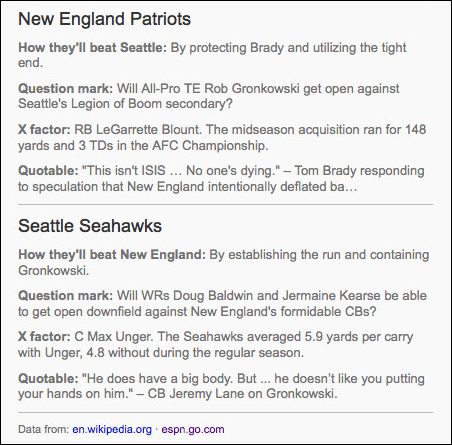
A little farther down the Snapshot content is a series of four factoids about each team (#6 above). It’s got a quote from each team, an “X factor” player, a “Question mark” and a “How they’ll beat” the other team statement.


Image Source: searchengineland.com
Here’s what’s interesting about this: Someone at Bing has written this content specifically for the search results page. I’ve asked Bing to tell more about this, but they haven’t answered yet. But I know this: Do searches for the exact phrases in this section — like “Will All-Pro TE Rob Gronkowski get open against Seattle’s Legion of Boom secondary?” — and you won’t find them anywhere else on the web in that exact wording. Bing credits the Snapshot data to Wikipedia and ESPN, but neither have the exact phrase “Will WRs Doug Baldwin and Jermaine Kearse be able to get open downfield against New England’s formidable CBs?” That’s original text on Bing’s part.

After that, the right side has things like related searches, related images, a couple ads and it ends with a recent Super Bowl-related tweet (#7 above).

What About Google?

Google’s search results page for the same query this morning is nothing like Bing’s. It’s kind of shocking that such a popular cultural event only gets a basic Onebox treatment on Google, followed by the standard news and website links.

Google isn’t even showing video or image results for this query.

Final Thoughts

As someone who publishes a couple websites, I’m normally not a fan of seeing search engines put so much content above search results like this — especially at the expense of online publishers providing that content. My U2 website is no doubt starting to lose traffic now that both Google and Bing are showing song lyrics right in the search results. Ugh.

So I understand why many of our readers won’t like the kind of search results page that Bing is presenting here for “super bowl,” but I like it. I think this is an amazing search results page. The best I’ve ever seen on Bing.

Zen Digital Fund’s Mitch Berman is a respected digital marketing strategist who is a great inspiration for anyone interested in carving his own niche in technology and media. Follow this Twitter account for more cutting-edge perspectives on the current issues and trends on media, technology, and digital marketing.

Tuesday, October 14, 2014

REPOST: Big brand advertisers want to find their logos in your pictures

A picture says a thousand words, even for businesses. TIME reports that digital marketing companies have started analyzing photos posted on Instagram and other photo-sharing sites to examine customer insights and market trends. Read the details below.

Image Source: playbookpublicrelations.com

That picture you posted on Instagram from the beach last week might have more useful data in it than you think.

Where are you? What do you have in your hand? Do you look happy or sad? What are you wearing? These are all questions that can help advertisers target their marketing to consumers, so a crop of new digital marketing companies has begun analyzing photos posted on Instagram, Flickr, Pinterest and other photo-sharing sites to look for these trends and insights.

Image Source: digitalmi.com

Ditto Labs Inc. uses photo-scanning software to locate logos in these personal photos (is the subject wearing a North Face jacket? Or holding a can of Coca-Cola?) and look at the context in which these brands are being used.

For example, according to the Wall Street Journal, Kraft Food Groups Inc. pays Ditto Labs to find their logos on Instagram and Tumblr. Ditto Labs then analyzes trends like what people drink when they’re eating Kraft products and how happy they appear to be. They are then placed into categories like “foodie” and “sports fan” based on how they’re eating their Kraft food.

Image Source: kingselitemedia.com

Digital marketing firms use personal photos in other ways, too; Piquora Inc. stores massive amounts of these images over a few months to look at trends over time.

This new brand of marketing research serves as a fresh reminder that the photos we put online are public, and once we click ‘post’ we lose control over who sees them and what they’re used for. “This is an area that could be ripe for commercial exploitation and predatory marketing,” Joni Lupovitz, vice president at children’s privacy advocacy group Common Sense Media, told the Journal. “Just because you happen to be in a certain place or captured an image, you might not understand that could be used to build a profile of you online.”  

Mitch Berman is the founder of Zillion TV Corp. and the CEO of Zen Digital Fund. Subscribe to this blog for the latest business and marketing trends.

Tuesday, April 1, 2014

REPOST: Challenge for digital marketers to keep up with innovation

In this article for The Belfast Telegraph, Norbert Sagnard shares the lessons he learned about digital marketing from the Mobile World Congress, one of the world's biggest events in the mobile industry.


At the recent Mobile World Congress in Barcelona, I was reminded how digital innovation is impacting the practice of mobile marketing. What to do with 'cameras without lenses', or with 'proximity sensing' that allows you to move content on a smartphone screen without actually touching the screen, or with paying your retail purchases from a nod of your head?

Such new techniques always seem outlandish at first, yet they become the new normal for billions of smartphone users around the world rapidly.
Image Source: limexdesign.co.za

Technology breakthroughs are coming thick and fast, thanks to crowd-funding and angel investment, and accelerators like Wayra, where founders set up and grow their tech business and launch new products within a few months. The challenge for marketers is to stay up-to-date on new digital technologies, to engage and communicate with the billions of smartphone users – the general population in developed economies – who watch more video every day and adopt new ways of communicating through apps like Snapchat, Whatsapp and Telegram, ever faster.
The complexity and plethora of mobile technologies like augmented reality, frictionless payments, wearables, NFC, smartX – watches, fitness trackers, houses, cars – forces creative professionals to adapt brand stories leveraging the technical capabilities of the moment. This begs the question, can marketing innovation only be subordinate to digital innovation?
Image Source: theguardian.com

Over the past decade, marketing has evolved into digital due to web innovation and is now exploding into a myriad of combinations in the mobile space, where both real and virtual worlds blend. Sci-fi movies seem to precede our reality with ever less delays, tricks from Star Trek and Minority Report are here today, but the fundamental question for marketers is which communication tools and style to use, in order to address the fickle mood of their audience, or to devise mobile commerce journeys that make shopping effortless and enjoyable from a mobile device.
The quickening pace of technology innovation sets us all, marketers, the challenge of dedicating ourselves to continuous learning, trialling, refining, adopting or discarding in weeks rather than months, new mobile technologies. We must make decisions fast, yet achieve the objective of raising brand differentiation, brand value and customer satisfaction, those timeless marketing values.

Follow this Mitch Berman Twitter account for more on the latest trends in digital marketing.

Sunday, March 9, 2014

REPOST: Casting Jesus is a key marketing decision

Casting Jesus for the big screen has always been a challenging feat. Fox News reveals what goes on in casting Portuguese actor Diogo Morgado as Jesus for the new film “Son of God.” 


Image Source: foxnews.com

They say you can never be too rich or too thin. Surely it goes without saying that you can't be too good-looking, either, right? Especially in Hollywood.

But in the popular new film "Son of God," Jesus is so, well, easy on the eyes that some are revisiting an age-old question that has vexed scholars for centuries:

Did Jesus really look like Brad Pitt, only slightly better?

OK, that exact question hasn't vexed scholars for centuries. But those who study religion as portrayed in popular culture do note that depicting Jesus on the screen has always been a tricky business, one that balances weighty theological concerns — how divine to make the son of God, and how human? — with more earthly ones, like how best to sell movie tickets?

"Listen, films are big business," says Steven Kraftchick, professor at Emory University's Candler School of Theology. "They're probably not going to cast Jonah Hill as Jesus."

Not that Hill wouldn't provide an interesting spin. But the producers of "Son of God," Roma Downey (who also plays Jesus' mother Mary) and her husband Mark Burnett, were clearly going for something different when they chose the strapping, 6-foot 3-inch Diogo Morgado, a Portuguese actor who's dabbled in modeling, for "The Bible," their History channel miniseries. ("Son of God" is culled from footage shot for the series).

Downey won't deny her Jesus is good-looking — not that she'd get very far with that — but explains she was seeking a subtle mix of qualities. "Someone with strength, presence, charisma, tenderness, kindness, compassion and natural humility," she says. "Someone who could be both a lion AND a lamb."

Casting came down to the wire. A few weeks before shooting was to begin in Morocco, there was still no Jesus. Downey fired off an email to church and business contacts with the urgent header: "Looking for Jesus."

Salvation came from an unexpected place. In Ouarzazate, Morocco, a member of an advance team remembered an actor who'd been there more than a year earlier on a different project. He searched through hotel registries and found the name.

Not surprisingly, Morgado's looks have been a big part of the conversation ever since. "We not only found Jesus, we found 'Hot Jesus,'" Oprah Winfrey told him in a TV interview, referring to a Twitter hashtag about the actor. "

A hunkier Jesus than necessary," Variety noted in its review of the movie. The Hollywood Reporter called it "Jesus as pretty boy," and noted a resemblance between Morgado and the young Marlon Brando.

But box office is booming. "Son of God" came in a close second last weekend to Liam Neeson's "Non-Stop," beating out the blockbuster "Lego" movie.

To Morgado, it's all good. "Long after I'm gone, this is going to be my legacy," he said in a telephone interview. "So why should I worry about people calling me 'Hot Jesus'? I'm really proud of this movie."

His key acting challenge, Morgado notes, was getting that balance between divine and human: "It's a really tricky thing."

That's always been a problem, says Jeffrey Mahan, professor at the Iliff school of theology in Denver. "Jesus films go back to the very beginning of cinema, and there's always that tension between human and divine."

Mahan notes that "this isn't the first sexy Jesus on film." When Jeffrey Hunter played the role in the 1961 "King of Kings," he says, people dismissively dubbed it "I Was a Teenage Jesus," a reference to Hunter's youthful good looks (though he was in his 30s).

Some films, like the 1959 "Ben-Hur," avoided problems by not showing Jesus' face. Others, says Adele Reinhartz, author of "Jesus in Hollywood" and professor at the University of Ottawa, show a sanitized figure "that could have walked right out of a Renaissance painting." But they were always fairly good-looking: "These are marketing decisions."

The deeper problem with portraying Jesus, Reinhartz says, is that "to make a compelling movie character, you need flaws. And that doesn't fit into most conceptions of Jesus."

One exception was Martin Scorsese's 1988 "The Last Temptation of Christ," starring Willem Dafoe as a Jesus conflicted about his identity and experiencing earthly temptations, like lust. That didn't please everyone — a Christian fundamentalist group hurled Molotov cocktails at a Paris theater where it played.

Then there was Mel Gibson's 2004 "The Passion of the Christ," starring Jim Caviezel, an enormous hit which is deemed one of the most controversial films of all time, both because of its bloody depiction of the Crucifixion — Roger Ebert called it the most violent film he'd ever seen — and allegations of anti-Semitism.

Caviezel, Dafoe, Morgado — all give different interpretations, but they all look a certain way. None, for example, are dark-skinned, as some have speculated Jesus was. Others have noted that men of the time were significantly smaller than they are today.

"The fact is we just don't know how Jesus looked," says Kraftchick, at Emory. "How big was he? Did he have a speech defect?"

Downey, asked about the issue, points out that her Jesus is a Latino, and that in itself is groundbreaking. (The film is also being released in Spanish.)

What troubles Mahan is that heartthrob Jesus portrayals ignore that "Jesus was an outsider. And this 'pretty Jesus' is an attempt to make him sort of a celebrity. That isn't accurate according to the tone of the Gospels. "

Morgado says he's taking the long view.

"When I was in Jerusalem, I saw a man and a 10-year-old kid praying," he says. "And I looked at the kid and thought, 'Wow, I will be his visual and spiritual reference."

That's what producers are hoping.

"I think people who don't know Jesus will fall in love," Downey says. "And those who do know him will fall in love all over again."

Zen Digital Fund CEO Mitch Berman aims to harness creative talents and innovative digital entrepreneurs to help forge a new era in digital marketing. Follow this Twitter page for more news on marketing, media, and technology.

Sunday, February 9, 2014

REPOST: Enterprise software marketing: Sell the value, not the box

If you’re planning to put your software in the market, focusing on customer needs instead of your product features will give you a better boost in sales. Learn more about this technique in this article from ZDNet.com.

Many enterprise software startups view success as a simple equation: build a great product and the world will line up to buy. There are two problems with this logic. First, it assumes that great product always drives great success; and second, this thinking leads to feature-oriented, rather than customer-centric, decisions.

The tendency to focus on features rather than customer needs is understandable. After all, the team pours its life into refining the idea, building features, designing the UX, testing, and all the other incredibly demanding tasks associated with launching a product.

The drive to perfect features before achieving a profound understanding of customer needs, pains, and business context comes from the mistaken assumption that technology, like idealized love, can overcome any obstacle. This mindset pushes many startups to believe their core mission is creating a great product.

In a blog post and video, entrepreneur and Stanford professor, Steve Blank, challenges startups to rethink the fundamental nature of their challenge and goal. Instead of pushing for better product and technology alone, Blank defines a startup as:


Blank's perspective has three important implications for enterprise marketing and sales. Although tailored to startups, these points are equally valid for people in large or established software companies, who may forget their real job is satisfying customer needs and creating delightful outcomes for buyers:
  1. Customers are king. There is no substitute for spending time with real customers in your target market. Although the old adage, "the customer is always right" is often wrong, never forget that your company has little value outside the benefit it provides to customers. When it comes to selling, theories about the world are meaningless unless real customers actually buy.
  2. Markets don't buy, people do. The term "market" is an abstraction designed to generalize about groups of prospects or customers. In the zeal to identify target markets we may forget that individuals, not markets, issue purchase orders. Strategize for the market but sell to the person. 
  3. Sell value, not features. In enterprise software sales, feature wars push combatants toward commoditization — as software vendors leapfrog each other's feature lists, buyers learn to pay lowest dollar using missing features as the lever. Instead, build value by selling the meaning, not the box.
The best enterprise startups internalize the customer's mind so thoroughly that the resulting product actually anticipates customer needs. Products that meet this high standard are virtually always grounded in a deep and profound understanding of the customer; it rarely happens by chance.
In my experience, startups who don't get this message drift from one solution to another, never getting the traction they need. And large companies who focus on features, rather than real value, end up looking like their competitors in an endless cycle of non-innovation.

Mitch Berman, the founder of ZillionTV Corporation, has over 30 years of experience in domestic and international consumer and enterprise marketing, operations, and sales. Visit this Facebook page for more information about his career.

Thursday, January 16, 2014

REPOST: Tradigital Marketing: How to integrate traditional and digital marketing for maximum results

In this article from The Business Journals, John Garcia discusses tradigital marketing--the integration of traditional and digital marketing strategies--as the most effective way to reach target audience, score high conversion rates, and make the most sales.

Image provided by ThinkStock (Oleksiy Mark) Image Source: bizjournals.com


There is a paradigm shift regarding the way people consume media.

Media that includes newspapers, television, magazines, radio, direct mail and the Internet are now the conversation starters, and digital is the new destination. People want to know where to go online to either get the rest of the information, sign-up for, or download the offer.

In other words, it is not "traditional" vs. "digital," its "tra-digital" that will garner the best results.

For starters, there are far too many "digital" ad agencies that want to tell you that traditional media is dead — that no one reads the paper or listens to radio anymore. They want to take your ad dollars and put all of them in search engine optimization (SEO), search engine marketing (SEM), and a brand new website.

While it may seem like good advice, this is not a good strategy. The truth is traditional media is not dead, but its role has changed dramatically.

For one thing, a digital agency only knows digital and therefore only recommends digital solutions. Even so-called “full-service agencies” are often guilty of separating traditional and digital marketing strategies, doing a disservice to their clients.

A quick case in point is Ironhorse Country Club. The club came to our agency after years of advertising a discounted-fees ad in the local newspaper (“bring in the coupon or call to schedule a round”). The club’s goal was to add a minimum of 25 new members in Q4 2012. We reallocated its budget, and for the same amount of money that they were spending in print, we created two 15-second commercials and ran them locally during two televised golf tournaments, The Fed-Ex Cup and The Ryder Cup.

The results were 92 new memberships — A 300 percent increase. All we did was use a media vehicle that best reached the club’s target audience with a simple call to action: “Visit Ironhorse Membership dot com to schedule a free membership preview round."

This TV campaign generated more traffic to the landing page than any SEO, SEM or other digital campaign could ever have in such a short period of time. The landing page made it easy for the prospect to continue down the sales funnel, and the excellent service by the advertiser closed the deal.

The takeaway: A tradigital strategy that is highly targeted, using a well-crafted ad, and directing its audience online will deliver the highest conversion rate because it mirrors the mindset of the advertiser’s audience.

Next month we’ll discuss the five basic steps to a successful tradigital marketing campaign.


Mitch Berman is a pioneer in the creation of innovative digital consumer and business-to-business products and services based on the principles of influence, sharing, and reward.  Follow this Twitter page to keep abreast of the latest marketing updates.

Wednesday, December 18, 2013

REPOST: On Cyber Monday, Pinterest More Than Tripled The Revenue Sent To Online Retailers

TechCrunch reports that Pinterest, despite just recently opening up to advertisers, proved its capability to drive web sales by more than tripling the revenue of online retailers on Cyber Monday.


Image source: TechCrunch.com

As Pinterest opens its doors to advertisers, retailers have been carefully monitoring the service’s ability to drive traffic to their sites, and more importantly, increase conversions that impact their bottom lines.

Over the Black Friday/Cyber Monday shopping holidays, Pinterest delivered on this promise – or so claims a new report from marketing and analytics provider firm Piqora. The company found that Pinterest doubled the revenue sent to retailers on Black Friday, and more than tripled the revenue (up by 3.6x) on Cyber Monday, when compared with the 30-day average preceding the Thanksgiving holiday.

And since the after-Thanksgiving sales began a little early this year, it’s also worth noting that Pinterest drove two times the revenue on turkey day as well.

According to Piqora CEO Sharad Verma, whose company helps retailers and other brands market themselves across the “visual web” on sites like Pinterest, Instagram, and Tumblr, what the Black Friday/Cyber Monday figures show is that Pinterest users aren’t just “pinning for the sake of pinning.”

That discounts a widely held assumption that users on the site have been saving items they found there in a more “aspirational” manner, rather than a practical one. Or to put it more simply, there was concern that a Pinterest save didn’t indicate buying intent.

Says Verma, that’s not so. “[Pinterest users] are pinning to buy and they are going to Pinterest to look for products to buy. They thought of Pinterest as a destination for their holiday shopping circuit,” he explains. “That never happened with F-commerce or Twitter, else we would have known it by now.”

However, though revenue sent to retailers via Pinterest increased over these recent, lucrative shopping days, traffic across the site remained flat. This is because users on Cyber Monday and the like are more in “buying” mode, and less in “collecting or discovery” mode, so the overall clicks on pins and outbound traffic didn’t see any meaningful jump.

But though there were not more clicks, the clicks Pinterest delivered those days were more profitable. “We know that Pinners pin before they buy, and they click on their past pins when they are ready to buy them,” Verma says. “A bulk of those purchases (from self pins) happen between the second day of pinning and four weeks,” he notes.

For retailers, that means those who had optimized their websites for pinning ahead of the Black Friday/Cyber Monday benefitted the most. The higher the share of pins they offered, the larger their Pinterest catalogs, the more the clicks. And, apparently, the more revenue as a result.

For this latest report, Piqora also took the time to study the top tags and images across the site during the Black Friday/Cyber Monday shopping days to determine what exactly people were pinning and buying. Not too surprisingly, given the season, the answer was simply “boots and coats.”

Though the findings are a bit self-serving given Piqora’s interest in helping companies market themselves on Pinterest and elsewhere, its data holds up against reports from others which also previously found Pinterest capable of driving more social media traffic and revenue than Facebook or Twitter. Large retailers are abundant on the site, and though they may not discuss their exact numbers, many have been shown to be very bullish on the benefits of being on Pinterest.

For instance, Nordstrom embraced Pinterest so fully that it’s testing popular Pinterest items on floor displays, and armed sales staff with iPads which contain an internal app showing the most pinned merchandise. Meanwhile, Lowe’s director of social media, Brad Walters, said in an interview earlier this year that the company would consider Pinterest’s advertising platform.

Though Pinterest is a young site, has raised a massive amount of funding which values the business at $3.8 billion, and is only now launching its own advertising platform, the company has momentum among online retailers. According to Internet Retailers’ October study, 59.5% of respondents said they would increase use of Pinterest this holiday season compared with last year. For comparison’s sake, 54.8% said the same about Facebook, and 32.6% said so for Twitter. In addition, 78% of the retailers in the site’s 2013 Top 500 Guide are active on Pinterest.


Mitch Berman is the brains behind Zen Digital Fund, a technology and digital marketing company. Visit this Facebook page for more discussion on the future of digital marketing.

Friday, November 1, 2013

REPOST: Patent wars: Tech giants sue Samsung and Google

The mobile phone patent war thickens as Rockstar Consortium, an alliance of Apple, Microsoft, Blackberry, Ericsson, and Sony, has filed a patent infringement lawsuit against Google, Samsung, and other smartphones that run the Google Android operating system. BBC News has the full report. 

Image Source: bbc.co.uk
 

A group of tech giants known as the Rockstar Consortium is suing Google, Samsung, HTC and others over alleged mobile phone patent infringements.

Rockstar, jointly owned by Apple, Microsoft, Blackberry, Ericsson and Sony, is targeting manufacturers of phones that run the rival Google Android operating system.

Rockstar spent $4.5bn (£2.8bn) buying thousands of Nortel patents after the telecoms giant went bankrupt in 2009.

Google lost out in the bidding war.

The Rockstar lawsuit claims Google has infringed seven patents relating to the way internet search terms match up with relevant advertising.

Dominance

The move is just the latest in a number of mobile device patent cases being fought across the world, as technology behemoths fight for dominance of the lucrative smartphone, tablet and games console markets.

Google's Android has been doing particularly well, largely thanks to the success of Samsung's Galaxy range of smartphones.

Android devices accounted for 81.3% of smartphone shipments in the third quarter of 2013, according to research firm Strategy Analytics, compared with 13.4% for Apple iOS and 4.1% for Windows Phone.

This week, Nokia, whose mobile devices division is being bought by Microsoft, won a patent victory over HTC that could see the Taiwanese company's HTC One smartphone being banned from import into the UK.

And earlier in October, Samsung offered to stop taking rivals to court over alleged patent infringements for a period of five years, after European Union authorities said the South Korean company's litigious actions were stifling competition.

Samsung faced a potential £11.3bn ($18.3bn) fine if found guilty of breaching European anti-trust laws.

Google's Motorola Mobility, which the search giant bought for $12.5bn, has also been accused of similar anti-competitive behaviour.

Samsung and Apple are currently slugging it out in the courts of more than 10 countries across Europe.

Cross-licensing

But some senior technology experts believes the legal conflict is bad for consumers.

In an interview with the BBC's Click programme to be broadcast on Saturday, Apple co-founder Steve Wozniak says: "There are good things I see on Samsung phones that I wish were in my iPhone; I wish Apple would use them, and could use them, and I don't know if Samsung would stop us.

"I wish everybody just did a lot of cross-licensing and sharing the good technology; all our products would be better, we'd go further.

"I do kind of wish they were more compatible."

But the Rockstar Consortium's legal action suggests such a rapprochement in the global patent wars is still a long way off.

Mitch Berman is a digital evangelist who runs Zen Digital Fund, a dynamic organization focusing on the creation of the innovative "digital" consumer. Read this blog to learn more about his work in the digital media.

Monday, October 7, 2013

REPOST: How to build an effective social marketing strategy

Businesses act according to a strategy they believe would get them a better position in the market.  Forbes contributor Greg Satell provides tips in building an effective social marketing strategy for the digital age:
In the 20th century, nearly every marketing problem had one solution—the 30 second TV ad.  If you had a product to sell, you could reach everybody you needed to with a powerful, highly polished message in a very short period of time.
Yet marketing in the digital age is different.  Building awareness is no longer sufficient.  In fact, it may even benefit your competitors more than it does your brand because once consumers react to your message, they will be retargeted using digital methods.
So the basic function of marketing promotion has changed.  It is no longer enough to simply grab attention, you need to be able to hold attention and that’s where social strategy comes in.  The age of catchy slogans and massive ad campaigns is over.  Brands in the 20th century need to become more like publishers and strategy needs to follow from that.
Brands like Harley Davidson built strong communities long before social media even existed. Image Source: www.forbes.com
Clarifying The Mission
Content strategy has become a popular specialty in marketing lately.  The problem is that very few content strategists actually know what they’re talking about.  They tend to approach content as if it was just a longer version of an ad and therefore double the usual amount of psychobabble about the “consumer mindset.”
In truth, a publisher’s first loyalty is not to the consumer, but to the editorial mission.  That doesn’t mean you should ignore consumers, trends or anything else that’s going on.  What it does mean is that great publications stand for something.
Apple stands for design.  Harley Davidson stands for friendship and camaraderie.  Red Bull stands for an extreme lifestyle.  These brands successfully engage consumers because the brand’s mission supersedes whatever they happen to be selling at any given time.
So the first thing you need to do to create a successful social strategy is figure out what you stand for.

Identifying Analogues

There is probably no greater peril in marketing than the misplaced compulsion to be original. Originality, after all, is not a virtue in and of itself, but only has value if it’s meaningful.  Try to be different for difference’s sake and you’ll accomplish nothing more than being weird.  That might thrill the guys in the office, but it will fail in the marketplace.
So the best way to start formulating a social strategy is to identify others who share your mission.  What are they doing?  What succeeds and what doesn’t?  What can we add?  What can we subtract?  There’s no reason to try to reinvent the wheel.
When I was a professional publisher, we would insist on 3-5 analogues for any development or editorial brief and we found that practice absolutely essential.  It not only helped us adopt best practices and avoid poor ones, it also helped everyone visualize exactly what we were trying to accomplish.

Focusing on Structure

Law and Order was one of the most successful TV shows in history.  Running for 20 seasons, it not only ruled the ratings, but was a critical success as well.
Regular viewers of the show became familiar with its strict structure.  First, a crime, then an investigation leading to an arrest and prosecution.  Somewhere along the way a snag would be hit, creating tension that would drive the story. You could almost set your watch by it.
Every successful content product has a clearly defined structure.  TV shows have plot formulas, radio stations have clocks, magazines have brand bibles and web sites have usability rules.  These are strictly followed.
While this may seem boring in concept, creating a clear structure is absolutely crucial in practice.  Any cognitive energy your audience uses up trying to navigate your content lessens the amount of energy they can spend on what you’re trying to tell them.  A standard format is also helpful in setting the constraints under which creativity thrives.
A legendary editor once told me that a great content product delivers two things: consistency and surprise.  I think the same is true with social marketing.  You should set expectations, but also feel free to break the rules now an then.  However, without consistency, there can be no surprise, you just make a mess.

Create A Community (Not An Audience)

Up till now, I’ve focused mainly on content.  That’s deliberate, because without compelling content that informs, excites and inspires, social marketing doesn’t have a chance.  It simply will not be effective.  However, the mark of a great social marketing program is that it builds more than an audience—it builds a community.
This is where things often go wildly, wildly wrong because social marketersmistakenly equate the strength of their community with the size of their following.  They establish fans on Facebook, Twitter and other social networks as a key performance indicator and then blast them with brand messages.
The truth is that the strength of your community has much less to do with how consumers are connected to you than how they are connected to each other. That’s how great social brands, like Apple, Harley and eBay built devoted followings long before anyone even heard of social media.
The bottom line is that we are now in a post-promotional age where brand messages are only half the battle.  To build a great brand today you need to build great brand experiences and the best way to do that is to build a community around shared values with content that holds attention.
Mitch Berman, founder of ZillionTV Corporation, currently works as a principal at Blend Digital, where he provides marketing strategies for privately-held and public companies that include IP-based digital entertainment, consumer marketing and branding, 2nd screen social TV, content licensing, connected devices, digital media business development and distribution, social and mobile media marketing.  Check this Facebook for more information on Mitch Berman.

Monday, July 22, 2013

Closing the gap in digital skills through training

Image Source: communitelligence.com

The digital world is growing at a pace where the skills of available manpower fall short of functional IT knowledge that could leverage big business solutions. Digital companies are set up with very particular industry focus. Hence, for young professionals actively seeking employment, there’s so much to learn and too few resources for them to be completely competent in IT areas such as persnickety analytics and big data management --- all worth billions of dollars when translated to consumer insight, market research, product designs, etc. The urgent issue is there – the need for more digitally skilled professionals, yet the real solution to the problem remains elusive.


Image Source: actionplan.gc.ca

However, IBM’s Anjul Bhambhri remarks that the viable solution to the digital skills gap might just be underplayed. In his article, Bhambhri writes how the industry could meet the challenge through company-sponsored training which is a key to improving both data skills set and employability. Training professionals with insufficient skills is still the best way for companies to have their existing workforce adjust to new sophistications in IT, and to redefine its data skills demand in terms of who they need and the skills they’re actually looking for. Training is also crucial in organizations that prefer versatile individuals who could work across diverse IT tasks.


Image Source: irishexaminer.com
 
Resolving the digital skills gap begins at a grassroots level – in school. Modifying the curriculum to accommodate vocational tech programs calls for renewed partnerships among schools, communities, and organizations which will direct future professionals to firsthand data science applications and equip them with on-the-job skills to cut through the robust world of big data.


Mitch Berman of Zen Digital Fund harnesses creative talents in the digital world as part of his commitment to ignite the creation of innovative "digital" consumer. Visit this Facebook page for more insightful analyses of the digital culture.

Monday, May 27, 2013

REPOST: The cult of 'Arrested Development'

"Arrested Development" hardly made waves in its day despite much critical acclaim.  It has recently been set for a rerun though, proving that in television, if you have the right amount of luck and popularity, you cannot stay out of the limelight for very long.  Find out more from this CNN article.


(CNN) -- Seven years after its finale, one of the greatest cult hits in television history is making a return. "Arrested Development" lasted three season during its initial run on FOX, with critical acclaim but dismal ratings.

Since its final episode aired in February 2006, a little thing called Netflix ushered in a new way of watching television. In doing so, the comedy found a massive following who kicked themselves for missing the dysfunctional antics of the Family Bluth before it received the dreaded "canceled" sentencing from prime-time television.

In a rare move, the Emmy-winning comedy is making a return, with 15 new episodes with the original cast and crew in tow. After a reported bidding war among outlets, Netflix won the rights to the fourth season everyone hoped for, but no one saw coming. After numerous false starts and scheduling conflicts, series creator Mitch Hurwitz was finally able to work in time for his entire clan to continue the saga of the least redeemable family in Orange County.

CNN recently caught up with the cast to discuss the new episodes, and star Jason Bateman appeared overjoyed at their family reunion.

"There really aren't a lot of shows that get to come back together, at least under these circumstances, where it's not a desperate retread and no one's really done much since the show went off the air. This was a celebratory gathering, a lot of good news, and we knew that we were being included in this effort that Netflix is making to change the way television is brought to people. We're just fortunate to be a part of that."

"Arrested" is the latest in Netflix's recent foray into producing original content, and marks a new way for people to enjoy television. For those who missed the show during its original run, Netflix made it possible to watch the entire series in one sitting. The increase in popularity for streaming and subscription services has created a culture of television binge-watching. Many fans of "Arrested Development" have never seen the show any other way, and on May 26, these same fans will have 15 new half-hours for their viewing pleasure. Portia de Rossi, aka Lindsay Bluth, admits to being a victim of binge-watching herself.

"I find it really frustrating to have to wait a week to watch a show, and I'm just so used to seeing things back to back when I want to see them. I think what Mitch has done with 'Arrested' for Netflix is even more brilliant because he's used that format and created something brand new within it."

With the abundance of reality series taking over both prime-time lineups and Nielsen ratings over the last decade, more and more people have begun turning to cable and premium networks to get their scripted television fix. Netflix is hoping to take a bite out of that population tuning away from the "Big Five" broadcast networks. In fact, these original series are even eligible for Primetime Emmy awards thanks to a recent rule change allowing broadband programming to be nominated alongside any broadcast, cable or premium network show.

Will the magic that has kept the original 53 episodes as must-see television a decade since the show's debut still be there? The cast believe so and if this upcoming season is a success, don't expect this to be the last you see of Never Nudes, Cornballers, and frozen banana stands. Bateman is quick to point out that Season 4 is the first arc in a new story.

"It's a three-act story that was too big to put in a feature, so we put the first act in these episodes and a movie would be acts two and three."

That's right, the long-rumored film version of the series is still in the works. The stars of "Arrested Development" may have to keep their characters within arm's reach in the coming future. They said they reveled at the chance to jump back into the shoes of their Bluth personae, and Jessica Walter had no trouble slipping into boozy matriarch Lucille.

"How bad does this make me seem? It's not that difficult. I hope I'm not like her! But when you play something for three seasons like we did, it's sort of like bike riding: You never forget. As soon as I saw the script and saw the people the first day we were all together in that dysfunctional crazy family, it all came back."

Season 4 features an interesting twist on the show's successful formula. To make the most of the limited time scheduled with the entire cast at once, each episode of the new installment focuses on a different member of the Bluth family. For de Rossi, it was the few scenes the ensemble got to shoot together that made her feel back at home.

"Once I was reunited with my cast on the set of Lucille's penthouse, that was that moment where it all just kind of clicked, for all of us. Because it wasn't just me and Lindsay and what she was like; it was how she related to everybody else and her place in the family. That was really awesome and that was when it all came rushing back."

With the release just a week away, will fans both old and new turn out to get a new slice of afternoon delight? De Rossi believes everyone will walk away satisfied.

"It's going to feel the same as it did. I was surprised how similar it looked and felt, and although we are all older, somehow it all worked."


Mitch Berman was instrumental in the launching of the wildly popular ZillionTV.  Catch insights on business and the television industry by following this Twitter page.

Monday, April 22, 2013

REPOST: A Comedy Show That Comes via a Hashtag

In this report, Amy Chozick digs deeper into the #ComedyFest event, a joint effort by Comedy Central and Twitter hinged on strengthening audience engagement using the power of comedic genres and multi-platform entertainment.


Image Source: nytimes.com


Next week, Comedy Central will host a five-day comedy festival that includes a lineup of legends like Mel Brooks and Carl Reiner alongside popular young comics like Amy Schumer and the director Paul Feig.

But there will be no smoky comedy clubs. No lone microphones and stools positioned on stage. No two-drink minimum.

The festival will take place almost entirely on Twitter, with comedians posting video snippets of routines and round tables and posting jokes using the hashtag #ComedyFest.

The partnership between Comedy Central, a cable cannel owned by Viacom, and Twitter represents the evolving relationship between television and social media. Twitter is often incorporated into programming with viewers using the site as a second screen while watching live television. But slowly, Twitter is becoming an outlet on which to watch video.

In January, Twitter introduced Vine, a video-sharing service that lets users post six-second clips — brevity that matches Twitter’s model of 140-character messages.

On Tuesday, as part of the festival, the comedian Steve Agee will host a “Vine Dining” party, telling stories in six-second videos. The cast of HBO’s “Veep” shares “vines” from the set, as does the cast of ABC’s hit “Scandal.” A&E puts 30-second videos of “Duck Dynasty” on Twitter and the entire third season of Fox’s “Raising Hope” had its debut on the site.

“It’s not just hashtags appearing on your TV screen, but TV content appearing in your Twitter feed,” said Debra Aho Williamson, a social media analyst at eMarketer.

For Comedy Central, the Twitter partnership is a small part of a larger strategy to become a branded entertainment company that does not rely just on nightly television viewing. In a changing media landscape, the channel’s series like “The Daily Show With Jon Stewart” and “South Park,” and their young, mostly male audiences, have led the shift to online video viewing.

As early as next month, Comedy Central will introduce a free, ad-supported app, called CC: Stand-Up. Designed to look and feel like a cable channel devoted to stand-up, the app will offer videos of comedians performing routines.

A recommendation algorithm (similar to the one used by Amazon) will allow users to discover new comedians. If you watched Jeff Ross, for example, a web of other comics would pop up based on routines with similar topics (like mass transit), style (like dark humor) or other relationships (both like marshmallows).

“One of these days we will be ambivalent about where people watch Comedy Central,” said Steve Grimes, the channel’s senior vice president for programming and multiplatform strategy.

At least for now Viacom makes the vast majority of its revenue from cable subscribers who watch television the old-fashioned way and the advertisers who pay to reach them there. The company must adapt to the changing ways viewers watch video, but they must also preserve profits.

Last year, Nickelodeon’s ratings dropped, partly because shows like “Dora the Explorer” and “SpongeBob SquarePants” had been too readily available on streaming platforms like Netflix.

Nickelodeon’s predicament has served as a cautionary tale for Comedy Central as it extends its programming onto other devices. Comedy Central’s total prime-time audience has fallen to a nightly average of 816,000 viewers in the current season to date, from 1.1 million in 2008, according to Nielsen.

Of those viewers, 258,000 are men ages 18 to 34, a demographic that disproportionately uses social media while watching television. In a study conducted by Nielsen in September and titled “How Chatter Matters in TV Viewing,” 54 percent of 18- to 34-year-olds said they had started watching a TV show because of Facebook, and 21 percent credited Twitter.

Fred Graver, head of TV at Twitter, said partnering with Comedy Central and others was not about turning the service into a television distribution platform, but developing deeper relationships with programmers that eventually lead to more people joining Twitter. The relationship, he said, can be mutually beneficial.

“What we spend a lot of time talking to networks and show runners about is, What do you put onto Twitter that will get people to change the channel or alert them to another way of enjoying the show?” Mr. Graver said.

For now, Comedy Central looks at the Twitter partnership as a marketing strategy. In the future, the channel could work with a sponsor to bring in ad revenue. “It’s the same way we’d market our comedy through a billboard a few years ago,” said Michele Ganeless, president of Comedy Central.

Ms. Ganeless has overseen Comedy Central’s push into other expansions of the brand, including consumer products like DVDs, T-shirts and coffee mugs related to its shows and comedians.

Comedians have been particularly ahead of the curve in embracing new ways to distribute stand-up acts that used to rely on cable television. Last year, Louis C.K. sold a “Live at the Beacon Theater” special directly through his Web site and made $1 million in under two weeks. That partly inspired Comedy Central to develop a Web site that lets comedians sell their stand-up specials directly to consumers (with the channel getting a cut). Customers can buy a stand-up special starting at $5 and stream it onto their television screens or mobile devices.

It remains to be seen how all these add-ons will ultimately affect Comedy Central’s audience and, in turn, its revenue.

“I don’t think anybody is moving forward in the TV business or the brand business without finding ways to develop a true dialogue with consumers,” said Doug Herzog, president of Viacom Entertainment Group, which includes Comedy Central, Spike and TV Land. “What we’re still discovering and what will take a while is what exactly does that mean and what exactly does it add up to and how do you quantify it?”

On Monday, Twitter will live stream the only #ComedyFest event that will take place with an actual audience, at the Paley Center for Media in Los Angeles. The panel discussion will include Mr. Brooks, Mr. Reiner and Judd Apatow, who will be the host. Mr. Reiner and Mr. Apatow will try to persuade the technology-averse Mr. Brooks to join Twitter. He has previously resisted, telling friends that it could not possibly capture his “impish” quality.

Mr. Reiner has more than 20,400 Twitter followers. During the Oscars this year, he posted, “I was so excited to discover I was not in the in memoriam!”

In an interview, Mr. Reiner took a break from writing a book, “I Just Remembered,” (“because it’s about all the things I forgot to put in the first book”) to discuss social media and comedy. Of Mr. Brooks, his longtime friend and partner in “The 2,000 Year Old Man” comedy skit, Mr. Reiner said: “We’ll see if we can get the old man to talk” on Twitter.

Mitch Berman, founder of ZillionTV Corporation, is a specialist in digital consumer innovation and multi-platform entertainment. Visit this Facebook page to know more  about the latest trends in consumer technology and social media.